How many calories does incline walking burn?
Incline walking usually uses more energy than the same speed on level ground because each step includes a vertical component. The size of the difference depends on the grade, your speed, your body weight and the minutes you actually spend moving. A 5% treadmill grade can be a meaningful increase over 0%, but it is not a fixed promise for every person or every machine. Use the table and formula below to compare like-for-like sessions, then use the full walking calculator when you want to enter your own time, speed, surface and weight.
- Grade is a percentage, not an angle. A 5% setting means about 5 units of rise for every 100 units of forward travel.
- Speed and grade work together. Slowing down on a steep setting can be more realistic than keeping a flat-walk speed.
- Body weight and moving time scale the estimate, so two people can walk the same hill and receive different results.
- Handrail support, pauses, treadmill calibration, stride and terrain can move real energy use above or below the estimate.
- The number is best used to compare repeated walks, not as a precise food budget or a guarantee of fat loss.
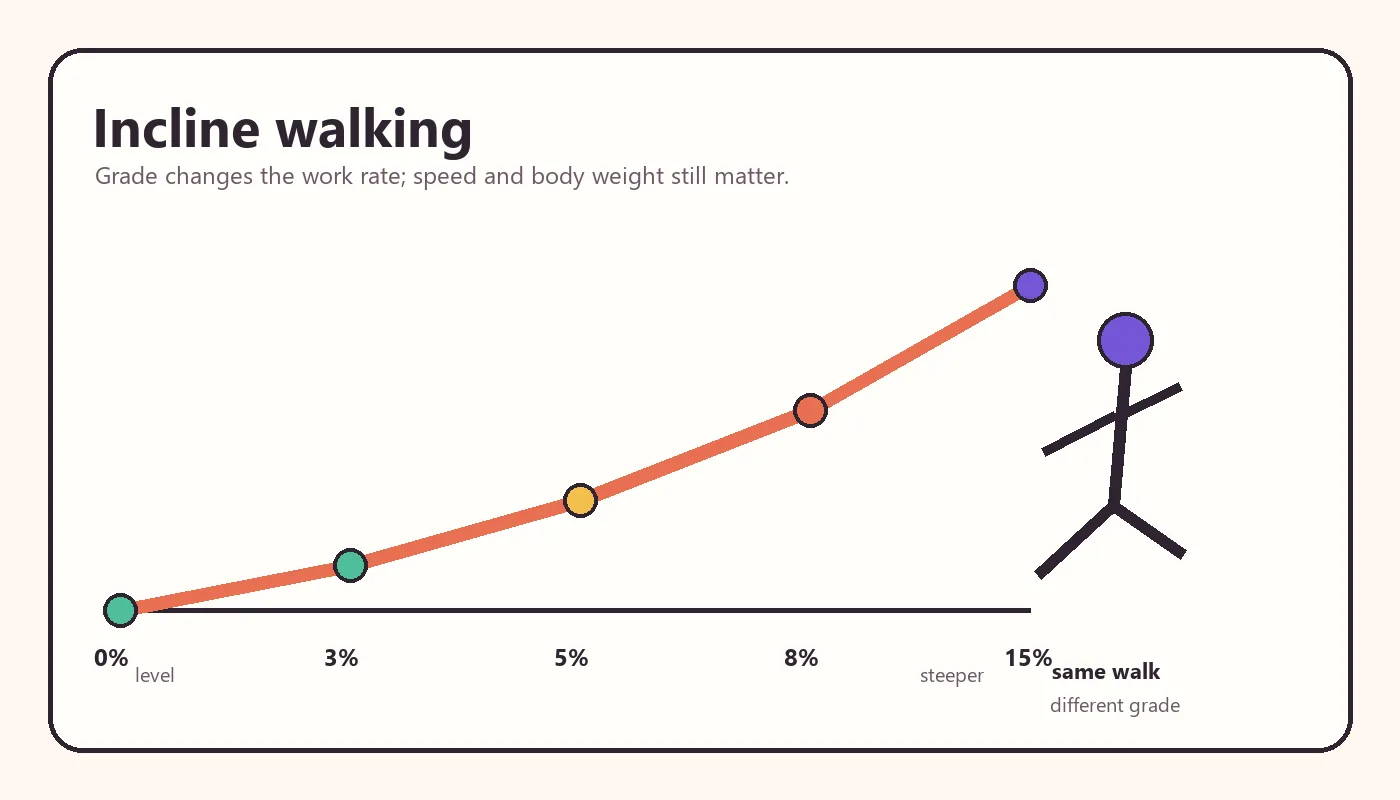
Incline walking calories by grade
These rows describe how to interpret common grades in an incline walking calorie calculator. They are comparison bands, not a claim that every person burns a fixed percentage more at one setting.
| Grade | Typical use | What changes in the model | What to watch |
|---|---|---|---|
| 0% | Level treadmill or path | Baseline for forward walking without an added uphill component. | A treadmill at 0% may feel slightly different from outdoor walking. |
| 3% | Gentle uphill walk | Adds a small vertical demand while many people can keep a natural pace. | Do not assume the same pace is comfortable for every body. |
| 5% | Steady incline session | Raises modeled work enough to make a clear flat-versus-uphill comparison. | Shorten the session or slow down if form changes. |
| 8% | Challenging hill intervals | The vertical term becomes more prominent and the same speed feels harder. | Use controlled intervals and avoid leaning heavily on the rails. |
| 10–15% | Steep treadmill work | A high grade can dominate the estimate even when the belt speed is modest. | Treat it as a demanding setting and stop for pain, dizziness or unusual breathlessness. |
A calculator may use MET bands or the ACSM walking equation. Either approach is an estimate; do not combine a grade adjustment with a separate hill multiplier unless the method explicitly says to do so.
Use an incline walking calorie calculator in four steps
The most reliable comparison comes from describing one walk consistently. Record the moving time, match the displayed speed, and enter the grade as a percentage.
Record moving time
Count the minutes you were actually walking. If you paused to adjust the machine, drink water or rest, remove the longer pauses when you want a session-only estimate.
Match speed and grade
Use the treadmill display or a measured outdoor pace. Enter 0% for level ground and the displayed percentage for an incline; do not turn 10 degrees into 10% without checking the equipment.
Use a current body weight
The MET formula scales with kilograms. A recent, approximate value is more honest than a very precise number from an old weigh-in.
Compare, then repeat
Read total calories and the per-hour or per-distance value. Repeat the same inputs next week to see a trend, rather than comparing a flat walk with a steep interval as if they were identical.
How the incline walking calorie formula works
A transparent estimate starts with an activity intensity, usually expressed as MET. The common calorie conversion is based on body weight and minutes. Incline-specific methods either choose a higher MET band for the grade or calculate oxygen cost from speed and grade, then convert that value to calories.
Calories = MET × 3.5 × weight (kg) ÷ 200 × minutesThe formula reports gross calories: the energy used during the activity period, including the energy you would have used at rest. A net-calorie method subtracts the resting component, so two calculators can disagree even when both use sensible inputs. Check which convention a page uses before comparing numbers.
For an incline session, grade changes the cost of moving the body upward. Speed still matters because a faster pace increases the horizontal cost and can change the selected intensity band. The calculator should use one clear method, show the grade assumption and avoid stacking multiple adjustments that describe the same uphill work.
Distance helps comparisons, but it does not show speed or stops. When tools disagree, align units, moving time, pace, grade, gross versus net calories and handrail use before comparing.
For background on walking metabolic equations, see the ACSM walking equation reference.
Incline walking calorie examples
These rounded examples use a 70 kg (154 lb) adult walking 30 minutes; they show direction, not personal targets.
| Scenario | Grade | Pace context | Modeled reading | How to use it |
|---|---|---|---|---|
| Level reference | 0% | about 3 mph | Lower baseline | Use it as the flat comparison for the same person and time. |
| Gentle hill | 3% | about 3 mph | Moderately higher | A practical first step when a flat walk feels easy. |
| Steady incline | 5% | about 3 mph | Clearly higher | Compare with the flat row; do not convert the gap into a promise. |
| Hard interval | 8–10% | slower as needed | High demand | Short blocks may be more realistic than holding the setting for 30 minutes. |
If you need a number for your own walk, use the site’s main walking calorie calculator with your weight, time, pace, surface and incline. Keep the same units and moving-time definition each time.
Four mistakes that distort an incline estimate
Most confusing results come from mismatched inputs rather than difficult mathematics. Fix the description of the walk before changing the formula.
Mixing percent and degrees
Treadmills normally display grade as a percent. A road angle in degrees is a different measurement. Copy the unit shown by the machine and keep the label beside your notes.
Counting the whole appointment
If a 45-minute gym visit contains 10 minutes of setup and rest, entering 45 as moving time overstates the walking portion. Use the minutes spent walking.
Keeping flat speed on a steep grade
A high grade often requires a slower pace. Enter the speed you actually maintained, not the speed you hoped to maintain before the session started.
Treating an estimate as a measurement
Rounded MET values cannot capture stride, heart rate or calibration.
How accurate is an incline walking calorie estimate?
Use an incline walking calorie calculator to compare similar walks, not to promise fat loss or measure individual metabolism.
Population equation
MET and oxygen-cost equations summarize typical adult activity. They do not measure your personal efficiency, fitness, body composition or heart response.
Real terrain is variable
Outdoor hills change grade and footing. Treadmills vary by calibration, belt, posture and handrail use. These details can move actual energy use in either direction.
Use a trend, not a promise
Keep the inputs consistent and compare repeated sessions. Do not use a rounded calorie number as a rigid eating target or medical measurement.
Incline walking calorie calculator questions
These answers cover the long-tail questions people ask when a treadmill display, fitness watch and calorie formula do not agree.
Does incline walking burn more calories than flat walking?
Usually, yes, when speed, body weight and moving time are comparable. The uphill component raises modeled work, but the size of the difference depends on the grade, pace, rails, pauses and method used.
What incline is best for burning calories?
There is no universal best grade. Choose a setting you can complete with controlled posture and repeatable effort. A moderate grade that you can sustain may be more useful than a steep setting that forces frequent stops.
Is a 5% treadmill incline the same as a 5-degree hill?
No. Treadmill grade is normally a percent, while degrees describe an angle. They are related measurements but not interchangeable numbers. Use the unit shown on the console.
How does body weight change the estimate?
The standard MET calorie conversion scales with body weight in kilograms. Heavier and lighter people can receive different estimates for the same time, grade and speed; this still does not measure either person directly.
Why does my watch show a different number?
A watch may use heart rate, motion, profile data and a net or gross convention. A simple calculator may use a fixed MET band. Compare inputs and conventions before deciding that one reading is wrong.
Can incline walking guarantee weight loss?
No. It can contribute to activity, but body-weight change depends on energy intake, total movement, recovery, health and many other factors. Treat a calorie estimate as context, not a guarantee.